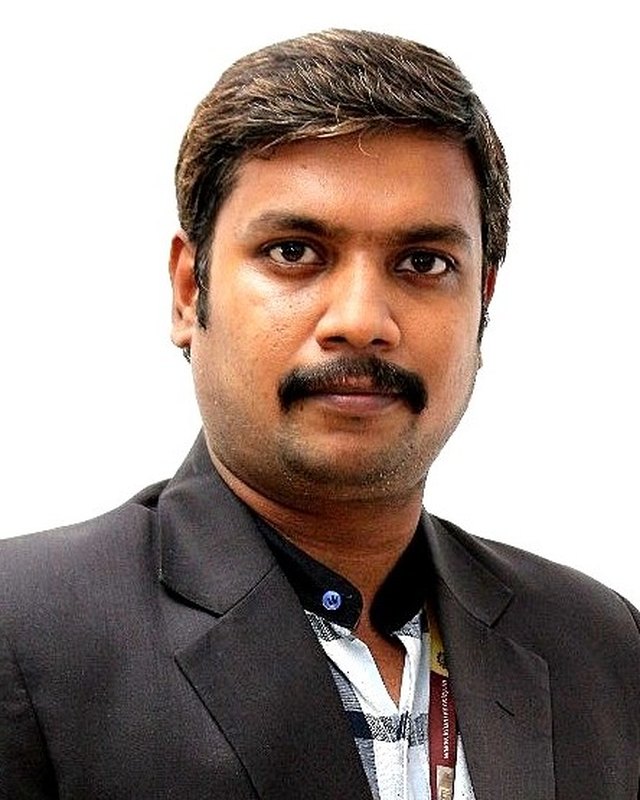
Carbon data is only as trustworthy as the people who decide how it is measured. MintCarb was founded by a technology builder and an emissions scientist who share one conviction: a carbon figure should be one you can defend in front of any regulator, auditor or investor.

Leads MintCarb’s product direction and the regulatory research the platform is built on.
Vijay Sekuru is the ideologist behind MintCarb. His work sits where carbon reporting has moved from voluntary to statutory — from the EU’s Carbon Border Adjustment Mechanism and India’s Carbon Credit Trading Scheme to disclosure regimes such as California’s SB 253. The hard part is rarely the calculation; it is the evidence behind it, and whether that evidence holds up in front of a verifier. MintCarb is built around that problem, across measurement, compliance, verification and reporting.
His career began in the early 2000s in computer graphics, animation and visual design, sharpened through years of teaching and studio work. Over two decades he grew that craft into end-to-end digital delivery — web and mobile applications, custom software, UI/UX, digital marketing and brand strategy — and into scaling teams and global operations across mobile, analytics and cloud, always with an eye for how a product looks, works and is used.
As a founder he builds ventures that pair creative craft with commercial delivery, among them a natural mother-and-baby care brand built on traditional, chemical-free formulations; as an advisor he helps shape brand narratives and the way organisations work. He writes and speaks on leadership in an AI-driven world and on healthier ways of working. The thread through all of it: turning creative insight into brands, products and teams that perform.

Asks of every emission figure what a scientist asks of any result: where did it come from, and can it be proven?
Dr Naga Chaitanya Kavuri is an environmental engineer whose work began where MintCarb’s hardest problems live — in heavy industry. His doctoral research at the National Institute of Technology, Rourkela, studied the air of the Indian steel city of Rourkela: characterising PM10 aerosols and tracing suspended particulates back to their industrial sources through source apportionment, published in peer-reviewed journals including Particuology.
That research joined field measurement, mathematical modelling and data analysis to attribute pollution to its sources and forecast it. It is the discipline MintCarb applies to greenhouse gas inventories, where a number is only as credible as the evidence and method behind it. His wider research spans air pollution, data-based modelling, bioremediation and environmental engineering.
He has also built institutions and ventures. As Associate Dean at K L University he established waste management systems that earned the university environmental awards; he founded Ishavasya Solutions and served as Chief Operating Officer of Arthashastra Intelligence Data Bases. He teaches Climate Technology at the Anant School for Climate Action, Anant National University, and helps build its research laboratories — preparing the engineers who will run the low-carbon industries MintCarb serves.
Carbon compliance fails in two places: the science behind a number, and the system that carries it into a filing. MintCarb's founders come from each side.
Methods grounded in how emissions are actually measured, attributed and modelled — not rules of thumb carried from one spreadsheet to the next.
Two decades of building technology for real users, applied to turning many frameworks and jurisdictions into one dependable workflow.
Research that began in a steel city, for a platform built for the high-emitting sectors that face CCTS, CBAM and investor scrutiny first.
Each number MintCarb reports can be followed back to its source record, its factor and its method.
Assurance, certification or a target is stated only when the record behind it exists.
The people who report data and the people who verify it work in separate roles with separate controls.
During early access, every briefing is led by the founding team — not a sales representative.
See the platform, test it against your own obligations, and ask the people who built it.